Chicago bungalow windows, and what replacement actually means for the type
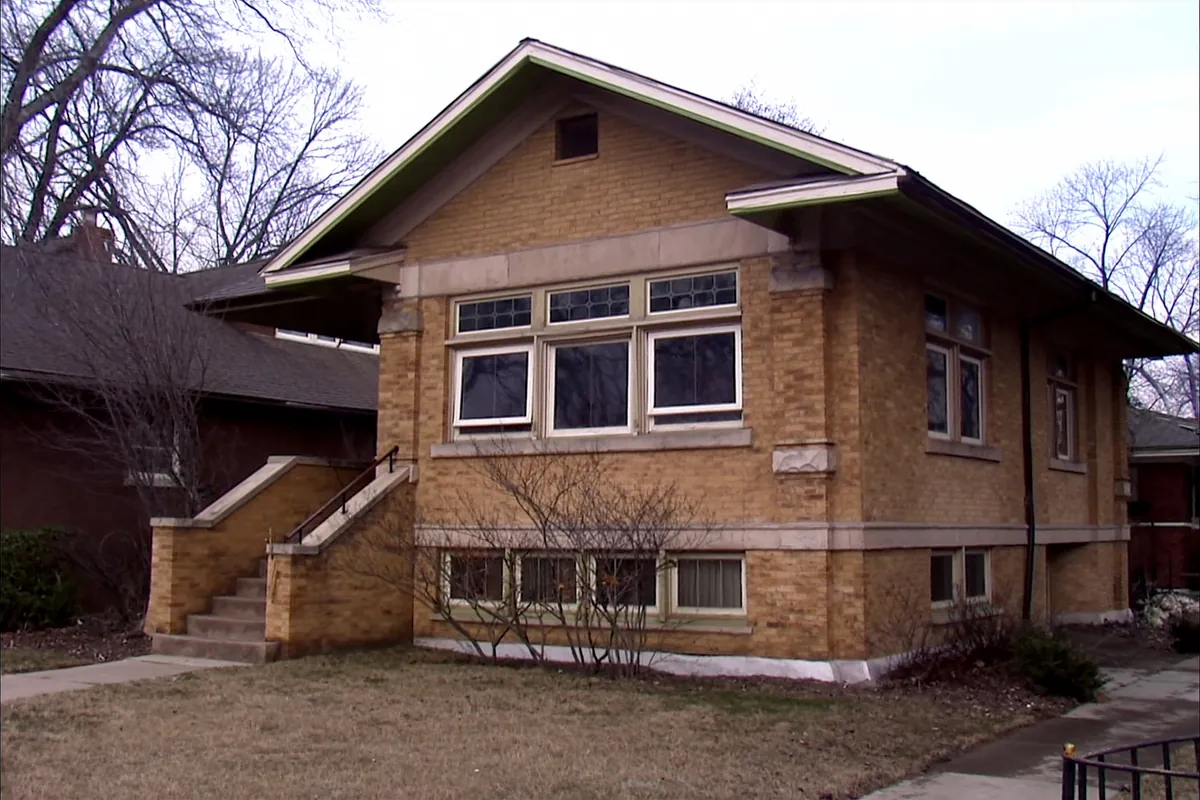
A Chicago bungalow changes the window job before anyone quotes it. More than 80,000 stand here, close to one third of the city's single-family housing, and the type is brick, one and a half stories above a full basement, with a low-pitched hipped roof and wide overhangs. The street-facing opening is normally not one window: the federal documentation for the type describes a bay carrying "one set of ribbon windows in a grouping of three or four windows into a single architectural frame". Art glass is common in that bay, usually already sitting behind a storm window, with metal muntins rather than wood. The association the city created tells owners not to "enlarge or reduce window openings to fit a stock window frame", so bungalow work is custom-size work. One piece of good news: at one and a half stories, an in-kind replacement in your existing openings is on Chicago's list of work that needs no building permit, unless your property is landmark.
Counts and form from the Chicago Architecture Center and the Chicago Bungalow Association, read 2026-08-11. The ribbon window description from the National Park Service documentation for the type, read 2026-08-11. Permit wording quoted from chicago.gov, read 2026-08-11. This page sits under the Chicago housing stock hub.
What counts as a Chicago bungalow, and why the dates disagree
The bungalow is the most documented house type in Chicago, and the three organizations that document it do not use the same years. That is three definitions written for three purposes rather than a contradiction, and it reaches you only where something turns on a build date, such as a district nomination. We publish the range rather than pick a pair of dates and pretend the disagreement is not there.
| Source | Era it gives | What it is defining |
|---|---|---|
| National Park Service, Chicago Bungalows Multiple Property Documentation Form | "built in Chicago between 1907 and 1930" | A federal registration definition, alongside one to one and one-half stories, brick exterior, rectangular plan, full basement, and a low-pitched roof with overhanging eaves |
| Chicago Architecture Center | 1910 to the mid 1930s | The architectural type as a public reference |
| Chicago Bungalow Association | 1910 to the mid 1930s on its type page, 1910 to 1940 in its design guidelines | The stock its guidance is written for |
All three read 2026-08-11. The federal wording is quoted exactly. The other two are printed as date ranges rather than sentences, so they are reported rather than quoted.
The form, in the words of the people who catalog it
The Chicago Architecture Center describes the type as one and one half stories above a basement, with a low-pitched hipped roof with wide overhangs, brick construction, and "Generous windows, sometimes with leaded art glass". Every one of those traits touches the window job. One and a half stories decides your permit position. The overhanging hipped roof is where the dormer and attic openings live. Brick decides how the opening was formed and what happens if anyone trims it. Generous windows in groups is why counting is hard, and leaded art glass is why the front bay is a different conversation from the rest of the house.
The Bungalow Belt is a real place, not a figure of speech
The Chicago Architecture Center puts it at "an arc 4- to 7-miles from downtown", and records that by the time the Great Depression hit, some 80,000 Chicago bungalows "stood in a great arc surrounding the city". Two authoritative publishers agree on what remains: the Chicago Architecture Center states Chicago "has more than 80,000 bungalows, which make up 1/3 of our city's single-family housing stock", and the Chicago Bungalow Association independently states that over 80,000 remain, nearly one third of the single-family stock. We found no Census or city tabulation counting bungalows specifically, so those two publishers are the whole evidence base for the number.
The front opening is a group, not a window
This is the single most useful thing to understand before a sales visit, and almost no national window guide mentions it, because outside Chicago the situation is uncommon.
The National Park Service Multiple Property Documentation Form names four bungalow bay forms: flat, square, polygonal and curved. On the flat bay it is specific: "When paired with an offset porch, the flat bay generally features one set of ribbon windows in a grouping of three or four windows into a single architectural frame." On the polygonal bay it records a different emphasis: "Chicago bungalows with polygonal bays often use the bay as a focal point on which to showcase art glass windows."
| Bay form | What the federal documentation says | What it means for your quote |
|---|---|---|
| Flat | Paired with an offset porch, generally one set of ribbon windows grouped three or four into a single architectural frame | One opening, three or four sash. The count you agree on decides whether two estimates are comparable |
| Polygonal | Often used as a focal point to showcase art glass windows | Angled jambs and a decorative center. The art glass question and the geometry question arrive together |
| Square | Named as one of the four forms. No further detail was read at the source | Measure it, do not assume it. We publish no description we did not read |
| Curved | Named as one of the four forms. No further detail was read at the source | The form most likely to defeat a stock unit outright. Get it measured before anything is priced |
National Park Service, Chicago Bungalows Multiple Property Documentation Form, prepared by Daniel Bluestone, University of Virginia, read 2026-08-11. The third column is our reading of the sourced facts, labeled as a reading. We did not invent detail for the two bay forms the documentation only names.
Openings or sash: the ambiguity that makes quotes look different
A bungalow front bay is one opening containing three or four sash. Elsewhere the same house carries dormer openings in that overhanging roof, attic openings, and basement openings under the raised first floor. Ask three contractors how many windows the house has and you can honestly get three different answers, because they are counting different things.
The fix costs nothing. Write the count yourself, both ways, before anyone quotes: openings, then sash inside each opening, room by room, plus attic, dormer and basement. Hand the same sheet to every contractor. That converts three estimates for three different jobs into three estimates for one job, which is the only condition under which comparing prices means anything. The same discipline runs through what is actually in a quote.
Art glass, storms, and metal muntins
The Portage Park Bungalow Historic District nomination is unusually precise about how surviving bungalow art glass is actually installed, and the detail changes the decision:
"thirty-three of the buildings in the district maintain their original and art glass windows, with some even retaining the mirrored angel gilding. Most of these art glass windows hang behind protective storm windows in the bays of the primary façade, featuring grids of metal muntins, abstracted florals, or Prairie-style motifs."
National Park Service, Portage Park Bungalow Historic District nomination, NRHP reference 14000620, read 2026-08-11.
Three operational points fall straight out of that sentence.
- The decorative layer and the weather layer are already separate. If your art glass hangs behind a storm, improving the weather performance of that opening is a question about the outer layer. It is not automatically an argument for discarding the inner one, and a quote that treats the two as one unit has skipped a decision you own.
- The muntins are metal, not wood. That matters the moment somebody prices a "matching grille". An applied grille in a different material and profile does not reproduce a grid of metal muntins, and on a street elevation the difference is visible from the pavement.
- Art glass is a repair trade. The association guidance below lists restoring or recreating art glass as a thing to do. Whether a contractor subcontracts that work, and to whom, is a fair question to ask before signing.
The Do and Do Not lists, in the association's own words
The Chicago Bungalow Association publishes design guidelines written specifically for this housing. Read the window section as a specification rather than as sentiment. It tells you what the type will and will not physically tolerate, and it is the closest thing to a Chicago-specific window standard that a bungalow owner outside a landmark district can hold a contractor to.
| The Do Not list, quoted | Why it is on the list |
|---|---|
| "Enlarge or reduce window openings to fit a stock window frame or change the shape of the window frames" | The commercially decisive line. It makes bungalow work custom-size work and rules out the cheapest way a supplier can solve a sizing problem |
| "Replace existing double hung or casement windows with single fixed glass picture or slider windows" | Changes the operation of the opening. It is also the change most likely to take the job outside Chicago's in-kind permit exemption |
| "Install glass block in-fill windows on the street facing elevations" | A common basement and bathroom solution that reads instantly as a later alteration from the street |
| "Replace existing attic windows with a slider window on the street facing elevations" | Attic openings are small, awkward and quoted carelessly, which is exactly why they get swapped for whatever is stocked |
| "Remove art glass windows" | The irreplaceable element of the type. Once it is skipped, no later owner can put it back |
| The Do list, quoted or reported | What it looks like in practice |
|---|---|
| Retain and repair original frames | Repair pricing on the frames you have, obtained before any replacement quote, so you know what the alternative actually costs |
| "Maintain historic muntin/grille pattern" | The divided-light pattern reproduced in the same arrangement, and on art glass those muntins are metal |
| "Restore or recreate art glass windows" | Recreation is named as acceptable, which matters where glass is already lost or broken |
| "Add thin profile wood or metal storm windows and screens similar in size, shape and color to existing windows" | The upgrade path that keeps the original glazing and needs no building permit anywhere in Chicago |
Historic Chicago Bungalow Association, Design Guidelines dated 6/21/2012, funded by the Richard H. Driehaus Charitable Foundation, read in full 2026-08-11. The association's own live windows page carries the same position: "Windows are a key architectural detail of a Chicago Bungalow", and "If windows cannot be repaired, replacements should match the historic window as closely as possible." Read 2026-08-11. The right-hand columns are our reading, not association text.
Why the resizing line is the one that costs money
Every other item on that list is about appearance. The resizing line is about the contract. When an opening does not accept a stock unit there are two directions to go: order to the opening, which costs more and takes longer, or alter the opening, which is cheaper, faster and permanent. A quote can take the second route without saying so, because from your side both versions look like "new windows, installed". The question that separates them is short: does this price change the size or shape of any existing opening, in any dimension? Get the answer in writing. It is also the question that decides your permit position.
What Chicago's permit rules do to a bungalow, specifically
The type sits on the comfortable side of every line the city draws, which is worth knowing before anyone quotes you for permit handling. Chicago publishes two lists of work needing no building permit. In any building, the list covers repairing damage to an existing window, replacing glass in an existing sash or door frame, replacing a ground-level window in kind where no part of the exterior wall is cut away, and installing, maintaining or removing a storm window or an insect screen. A second, broader list applies "in a residential building up to 4 stories above grade or an associated accessory building (such as a garage) on the same lot", and it includes "Repairing or replacing (in-kind) an exterior window or skylight in the existing opening."
| Bungalow situation | Position under the city's published lists |
|---|---|
| In-kind swap, first floor, existing opening | On the no-permit list. One and one half stories is inside "up to 4 stories above grade" |
| In-kind swap, attic, dormer or basement opening | Same list, same answer. The four-story test is about the building, not the floor. Ground-level in-kind replacement is separately exempt in any building where no part of the exterior wall is cut away |
| Repairing a window, replacing glass in an existing sash, or adding or removing a storm window or insect screen | On the no-permit list for any building at any height |
| Enlarging, reducing or reshaping an opening | Off the exemption. It is not in kind, and creating a new opening is not eligible for the streamlined permit route either |
| Double-hung or casement changed to a fixed picture or slider unit | Off the exemption on our reading, because the type has changed. It is also on the association's Do Not list |
| Designated or proposed Chicago Landmark, or a landmark district | Unsettled. The city says its exceptions "may not apply" and does not enumerate which survive |
City of Chicago, Guide to Building Permits, work not requiring a building permit, exterior worktype, read 2026-08-11. The right-hand column applies the city's published lists to bungalow situations and is our reading where marked. The full rule, quoted in both lists, is on do I need a permit.
The in-kind test and the design test are the same test
Chicago defines in-kind replacement as "replacement of existing materials, objects, or elements using new materials, objects, or elements of the same type, size, and shape." Set that beside the association's guidance and something convenient happens: the specification that keeps a bungalow looking like a bungalow is close to the specification that keeps the job inside the permit exemption. Same type, same size, same shape. A scope written in those six words satisfies both at once.
One caution, in the city's own words. The exemption removes the permit, not the code: "Any work performed without a building permit, as allowed by Section 14A-4-402 of the Municipal Code, must still comply with all applicable requirements of the Chicago Construction Codes."
If your job does need a permit
Some bungalow jobs leave the exemption: a new opening, a resized opening, or a change of window type. The city's Express Permit Program covers replacement in existing openings for a building up to seven stories tall, so a bungalow is well inside it. Three of its published terms constrain what you can buy, so read them before you design the job.
- No change to the opening. The terms state the permit "does not authorize any increase or decrease in the size of existing wall or roof openings", and does not authorize creating a new opening at all.
- No loss of glass area. A replacement "must have an equal or greater area of transparent or translucent glazing as the window or skylight it replaces". Thicker modern frames inside a fixed masonry opening are exactly how glass area gets lost, so this is a real constraint on a bungalow rather than a formality.
- No loss of openable area, and opening control devices where sills are low. In a residential building a replacement "may not have less openable area than the widows it replaces" (the city's typo, quoted as printed), and a replacement window "must include opening control devices that limit the opening to less than 4 inches within 42 inches above the floor when the windowsill is less than 36 inches above the floor".
- What is not eligible at all. Creating a new opening, a window that has or is required to have fire-rated glass, and a window within 10 feet of a fire escape.
Express Permit Program window and door replacement instructions and terms and conditions, read at chicago.gov 2026-08-11. Step by step on the Express Permit Program page.
Landmark status: two designations, and only one restricts you
Fifteen bungalow historic districts sit on the National Register under the Chicago Bungalows Multiple Property Submission, confirmed against the city's own list of Chicago listings on the National Register as of October 31, 2025: Auburn Gresham, Avalon Park, Brainerd, Falconer, Gage Park, Hermosa, North Mayfair, Portage Park, Rogers Park Manor, Schorsch Irving Park Gardens, South Park Manor, South Shore, Talman West Ridge, West Chatham and Wrightwood. Listing dates run from February 25, 2004 (Schorsch Irving Park Gardens and South Park Manor) to August 23, 2023 (Avalon Park).
That listing, on its own, restricts nothing about your windows. The National Park Service states it plainly: "Listing in the National Register places no federal restrictions or requirements on a private property owner. You may do with the property as you wish, within the framework of local laws or ordinances." It bites only where a project "receives Federal assistance, usually funding or licensing/permitting".
Those last eight words are the catch. Local law is a separate question, and in Chicago that means Chicago Landmark designation, a different instrument with different consequences. The city's Historic Preservation Division "reviews all permit applications for work involving designated and proposed Chicago landmarks and landmark districts", and directly under its no-permit lists the city warns that "These exceptions may not apply to work on a property that is a proposed or designated Chicago Landmark or part of a proposed or designated Chicago Landmark district."
No bungalow district appeared among the Chicago Landmark districts we reviewed, which is our reading of an incomplete published list rather than an all-clear: the city's own landmarks listings page states that it shows just a portion of the designations. If you are designated, the standard is the Guidelines for Alterations to Historic Buildings and New Construction, adopted March 4, 1992, which open by telling owners "not to replace them but rather to retain and repair the existing sash and frames", and require a total replacement to match the historic window "in design and operation, material, glass size, muntin arrangements, profiles, and trim such as brick mold and sill".
National Register list and landmark documents read at chicago.gov, 2026-08-11. National Park Service FAQs read 2026-08-11. One conflict recorded rather than hidden: chicago.gov dates the Brainerd listing December 27, 2016, and the Chicago Bungalow Association's own district page says January 6, 2017. We prefer the city. Full detail on how review works, what you submit, and how to check your address is on the landmark districts page.
How to check your own address
There is no instant single-address lookup on chicago.gov. The closest published instrument is the Chicago Landmark Address List, an August 2026 PDF organized as street name, address range and landmark name. Do not substitute the Chicago Historic Resources Survey for it: that survey, completed in 1995 and covering buildings built before 1940, identified 17,371 properties of historic or architectural importance, and appearing in it is not landmark designation. The reliable answer is the Historic Preservation Division, 312.744.3200, landmarks@cityofchicago.org.
The Chicago Bungalow Association, and what it gives you free
Most cities do not have an organization dedicated to one house type. Chicago does, and the city says it made it. The Department of Housing states that it "created the Historic Chicago Bungalow Association", that "In 2017, the Historic Chicago Bungalow Association changed its name to the Chicago Bungalow Association", and that "As of 2015, owners of all single-family vintage homes (built at least 50 years ago) are eligible to apply for membership and benefits."
Two of the listed benefits bear directly on this page: free design guidelines, and a "Window Campaign offers informational resources to homeowners on how to maintain and preserve historic bungalow windows." The published telephone number is 312.675.0300.
Why bother before a sales visit. The guidelines give you a written position from a body the city created that you did not invent. "The design guidelines say not to enlarge or reduce openings to fit a stock frame, so please quote to the openings" is a different conversation from "I want something that looks original".
City of Chicago Department of Housing, Historic Chicago Bungalow Initiative, read 2026-08-11. The association's own pages were read the same day. We publish no founding year for the organization, because the city's page gives none and no authoritative source was found.
Where the money goes wrong on a bungalow quote
Six failure points, each traceable to something above rather than to opinion. This is the list to read with two estimates side by side.
| Failure point | What it looks like | What to do about it |
|---|---|---|
| Opening count versus sash count | Two quotes differ by a third and both are honest, because one counted framed openings and one counted sash | Issue your own written count, both ways, before anyone prices |
| Stock sizing against a custom opening | A price that only works if the opening moves, without the quote saying the opening moves | Ask in writing whether the price changes the size or shape of any opening |
| Attic and dormer openings | Small, awkward openings priced as an afterthought, or swapped for whatever is stocked | Price them as named line items. The association guidance singles out attic sliders on street elevations |
| Art glass folded into a whole-house number | The decorative layer disappears into a lump sum and nobody has decided whether it survives | Separate the art glass openings from the rest of the job and decide them on their own |
| Grille pattern and material | "Matching grilles" quoted for a bay whose muntins are metal grids in an art glass panel | Ask what the grille is made of, where it sits, and what pattern it reproduces |
| Glass area shrinking inside a fixed opening | A thicker frame in the same masonry hole, so the visible glass gets smaller | Ask for the glass dimensions, not just the unit dimensions. The Express Permit terms hold permitted work to equal or greater glazing area |
Drawn from the sources cited above, all read 2026-08-11. The failure points are our reading of those sources applied to a bungalow, and are labeled as a reading rather than as city or association text.
How to write a bungalow scope, in the city's own vocabulary
One page, written by you, handed to every contractor. It is the cheapest thing on this site and it does more for the price you pay than any negotiating tactic.
- Openings, then sash. Number of openings by location, and the number of sash inside each. Attic, dormer and basement openings listed separately by name.
- Type, size, shape. State that every replacement is to be of the same type, size and shape as the existing, which is Chicago's own in-kind wording, and that no opening is to be enlarged, reduced or reshaped.
- Operation. Double-hung stays double-hung, casement stays casement. Name it per opening rather than for the house.
- Art glass, decided separately. Which openings hold it, whether it is retained, restored or recreated, and who does that work.
- Storms and screens. Whether existing storms are retained, replaced or removed. Thin profile storms similar in size, shape and color are what the association guidance names.
- Grille pattern and material. Pattern reproduced per opening, material stated, and whether grilles are between the glass or applied.
- Glass dimensions. Visible glass size per unit, not only the outside frame size.
- Permit position. Who is asserting the work is exempt, and on what basis, and what changes if it is not.
Sash types are covered in more detail on double-hung and casement, the bay geometry on bay and bow, and the outer layer on storm windows.
You may not need new windows at all
- The guidance written for this exact housing puts repair first. The association's Do list is retain and repair original frames, maintain the historic muntin and grille pattern, restore or recreate art glass, and add thin profile storms and screens. That is a maintenance path, recommended for the city's most common house by the organization the city created.
- Storm windows need no permit anywhere in Chicago. Installing, maintaining or removing a storm window or insect screen is on the city's no-permit list for any building at any height. So is repairing damage to an existing window and replacing the glass in an existing sash. One failed unit is a repair, not a whole-house project.
- Your art glass is probably already protected. The Portage Park nomination records most surviving art glass hanging behind protective storm windows in the primary façade bays. If that is your bay, the storm layer may be the upgrade with the best ratio of benefit to regret.
- In a landmark district, the city itself argues against replacing. The 1992 Guidelines put retaining and repairing existing sash and frames first, prefer replacing deteriorated parts to whole units, and say properly weather-stripped single-glazed sash "can greatly reduce or eliminate air infiltration between sash and frame where most energy is lost", at a cost the city calls nominal against the price of replacement windows.
- Price both paths before choosing one. Ask for a repair price on the frames you have, alongside the replacement price. The economics are worked through on repair or replace.
Chicago Bungalow Association design guidelines, the Portage Park nomination, the 1992 Guidelines and the city's no-permit list, all read 2026-08-11.
What we could not source, and will not guess
- What a bungalow window job costs. No Chicago price was read at a primary source for this pillar, so no dollar figure appears anywhere on this page. Read the cost pillar, which attributes every figure it publishes and states plainly where it has none.
- When the bungalow association was founded. The city states that its Department of Housing created the organization and that the name changed in 2017, but gives no founding year, and no authoritative source was found. We publish what the city states and not the year that circulates elsewhere.
- How many bungalows sit inside a historic district. Fifteen National Register bungalow districts are named above, but no publisher gave a readable count of buildings inside them, so none appears here.
- How many Chicago Landmark districts exist today. The city's open data answers, but its landmark districts dataset reports a last-updated date in 2011 and its most recent designation is from 2009. A stale count published as a current one is worse than no count at all.
- What the square and curved bays look like in detail. The federal documentation names all four bay forms but describes the ribbon grouping only for the flat bay and the art glass focus only for the polygonal bay. We did not fill in the other two.
Four questions worth asking out loud
Work in this order, because each step is cheap and can make the next unnecessary: settle designation with one call, read the free design guidelines, write your own count and scope, get a repair opinion on the frames you have, decide the art glass openings on their own, and only then collect quotes. Then ask, before signing anything:
- Does this price change the size or shape of any existing opening, in any dimension?
- How many openings, and how many sash, is this price covering, listed by location?
- What happens to the art glass and the existing storms, opening by opening?
- What are the visible glass dimensions of the proposed units, against the existing ones?
Where to go next
- Two-flat and three-flat windows, where the same projecting bay repeats on two or three floors and one measuring error multiplies.
- Greystone windows, where the opening is carved limestone and part of the ornament rather than a trim piece.
- Do I need a permit to replace windows in Chicago? Both exemption lists and the in-kind test, quoted in full.
- Landmark and historic district window rules, for what the Commission reviews and what you submit.
- The Chicago housing stock hub, for the four building types side by side.
Sources
All read 2026-08-11. Chicago Architecture Center: Chicago Bungalow. Chicago Bungalow Association: the type, windows, current bungalow historic districts, and its Design Guidelines dated 6/21/2012. National Park Service: Chicago Bungalows Multiple Property Documentation Form, Portage Park Bungalow Historic District nomination, National Register FAQs. City of Chicago: Historic Chicago Bungalow Initiative, work not requiring a building permit, exterior, Express Permit Program, window and door replacement, its terms and conditions, the Guidelines for Alterations to Historic Buildings and New Construction, adopted March 4, 1992, the Historic Preservation Division permit review page, National Register listings as of October 31, 2025, the Chicago Landmark Address List, August 2026, and the Chicago Historic Resources Survey search. No competitor page, contractor blog, retailer page, forum or search-engine summary informed any statement above.
If you want quotes to hold against the answers on this page, the form below is the place to start, free and with no obligation. What this site does, and does not do, is set out on the about page.
Cost and next step
What it costs, and what happens after you send the form
- What does window replacement cost in Chicago?
- The best-attributed Chicago-area figure we found puts it at $650 to $1,200 per window installed for a standard vinyl double-hung, and $6,000 to $16,000 for a 10 to 15 window whole-home job in Illinois. That is one publisher's read of a market, not a price list, and no agency publishes what window work costs. Source: Modernize, "Window Replacement Cost and Pricing in Illinois (2026)", Isabella Andersen, reviewed by Catie Bonner, updated March 18, 2026, read 2026-08-11. The cost section shows the full range, the sources that disagree, and why we do not average them.
- What happens after you send the form?
- Your request goes to an independent licensed local window contractor, usually within about an hour during the day. That contractor then contacts you to look at the windows and quote the work on their own schedule.
- What does this site help with?
- The guides here cover window types, materials, cost, permits, Chicago home styles, and hiring a contractor.
Free, and no obligation
Get free quotes on your Chicago windows
A marketing service, not a licensed contractor. Window work is performed by independent licensed local contractors.
Straight answers
Questions Chicago homeowners ask
- How many windows does a Chicago bungalow actually have?
- It depends on whether you are counting openings or sash, and that ambiguity is why two bungalow quotes can differ by a third without either being dishonest. The National Park Service documentation for the type describes the flat bay this way: "When paired with an offset porch, the flat bay generally features one set of ribbon windows in a grouping of three or four windows into a single architectural frame." So the front of the house is commonly one framed group holding three or four sash, and it is one opening. Add dormer, attic and basement openings elsewhere and the counts diverge again. Before you compare estimates, fix a written count both ways: openings first, then sash within each opening. Read at nps.gov, 2026-08-11.
- Can I use stock-size windows in a Chicago bungalow?
- Usually not without changing the building, and the organization the city created says so directly. The Chicago Bungalow Association design guidelines list, among things not to do, "Enlarge or reduce window openings to fit a stock window frame or change the shape of the window frames." The bungalow opening was built to the house rather than to a catalog, so the honest version of a stock-size quote is a custom-size quote plus carpentry that alters your elevation. Ask any contractor quoting stock units one question: does this price change the opening in any dimension? Design guidelines dated 6/21/2012, read 2026-08-11.
- Do I need a building permit to replace the windows in my bungalow?
- Usually no. Chicago publishes a list of work that needs no building permit "in a residential building up to 4 stories above grade", and it includes "Repairing or replacing (in-kind) an exterior window or skylight in the existing opening." A bungalow is one and one half stories above a basement, so it is comfortably inside that line at every floor. The catch is the definition: in-kind means "replacement of existing materials, objects, or elements using new materials, objects, or elements of the same type, size, and shape." Change the type, the size or the shape and you have left the exemption. Landmark property is treated separately, and exempt work still has to meet the Chicago Construction Codes. Read at chicago.gov, 2026-08-11.
- Should I replace my art glass with a modern insulated unit?
- Look at how it is actually built before deciding, because on many bungalows the decorative layer and the weather layer are already separate. The National Register nomination for the Portage Park Bungalow Historic District records that most surviving art glass there hangs "behind protective storm windows in the bays of the primary façade, featuring grids of metal muntins, abstracted florals, or Prairie-style motifs." If that describes your bay, the sensible upgrade may be the outer storm rather than the inner glass. The Chicago Bungalow Association guidelines list "Remove art glass windows" among things not to do, and list restoring or recreating art glass, and adding thin profile storms and screens similar in size, shape and color to the existing windows, among things to do. Read 2026-08-11.
- Is my bungalow likely to be in a historic district?
- National Register, meaningfully possible. Chicago Landmark, less so on what the city publishes. Fifteen bungalow historic districts are on the National Register under the Chicago Bungalows Multiple Property Submission, spread across the Bungalow Belt. That listing on its own restricts nothing: the National Park Service states that "Listing in the National Register places no federal restrictions or requirements on a private property owner." Chicago Landmark designation is the one that adds a reviewer, and no bungalow district appeared among the Chicago Landmark districts we reviewed. Treat that as our reading rather than an all-clear, because the city's own listings page says it shows only a portion of the designations. The reliable check is the Historic Preservation Division at 312.744.3200 or landmarks@cityofchicago.org.
- What does the Chicago Bungalow Association give a homeowner?
- Free published guidance aimed at exactly this problem, and it costs nothing to use before a sales visit. The City of Chicago Department of Housing states that it created the organization, that the Historic Chicago Bungalow Association changed its name to the Chicago Bungalow Association in 2017, and that "As of 2015, owners of all single-family vintage homes (built at least 50 years ago) are eligible to apply for membership and benefits." Among the listed benefits are free design guidelines and a "Window Campaign offers informational resources to homeowners on how to maintain and preserve historic bungalow windows." The published telephone number is 312.675.0300. Read at chicago.gov, 2026-08-11.
- What does a bungalow window job cost in Chicago?
- No figure appears on this page, and that is deliberate. This site publishes a price only with the source it came from and the date it was read, and no Chicago bungalow window price was read at a primary source. A custom-size front bay carrying three or four sash, a pair of attic openings, art glass with metal muntins and a set of basement openings are four different cost problems in one house, so a single range would mislead more than it helped. Read the cost pillar, which attributes every figure it publishes and says plainly where it has none, then make every contractor price one identical written scope so the estimates are actually comparable.
Before you sign anything
Get quotes you can actually compare
Tell us how many openings you have and where in Chicago you are. Quotes come back free and with no obligation, priced on your actual openings rather than on a published range.
Get quotes